
EU Leaders Advance Plans to Fund Ukraine, Consider Massive Loan Using Frozen Russian Assets

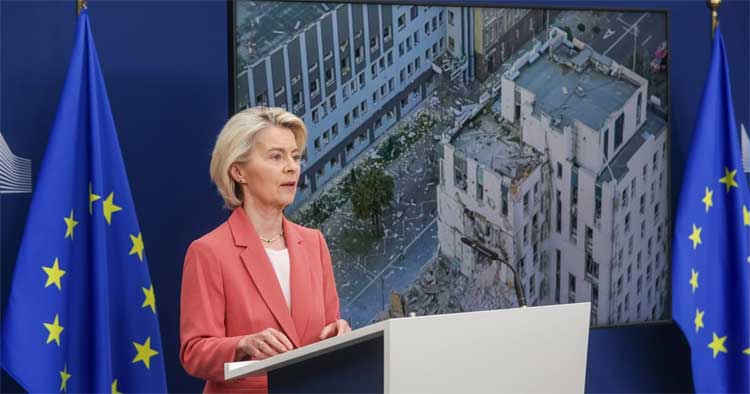
European Union leaders on Thursday instructed the European Commission to move forward with funding options to support Ukraine for the next two years, keeping open the possibility of a massive €140 billion ($162 billion) loan backed by frozen Russian assets.
After marathon talks in Brussels, EU leaders adopted broad conclusions that stopped short of approving the “reparations loan,” deferring a final decision to December. Diplomats said the agreement marked progress toward a potential deal, though it was softened amid objections from Belgium, which holds most of the frozen Russian central bank funds.
European Council President Antonio Costa said the bloc was committed to ensuring Ukraine’s financial stability. “Russia should take good note of this: Ukraine will have the financial resources it needs to defend itself,” he told reporters.
Roughly €200 billion in Russian central bank assets were frozen after Moscow’s 2022 invasion of Ukraine. The European Commission has proposed using those assets to finance Kyiv’s defense through loans, without outright seizure.
Commission President Ursula von der Leyen said the summit reached consensus on the goal but not yet the mechanism. “We agreed on the ‘what’ — the reparations loan — and we have to work on the ‘how,’ how we make it possible,” she said.
Ukrainian President Volodymyr Zelensky, who attended the summit, welcomed the outcome as a sign of “political support” for using Russian assets to sustain Ukraine’s war effort.
Belgium’s Legal Concerns
Most of the frozen funds are held by Belgium-based Euroclear, which has raised legal concerns about the proposal. Belgian Prime Minister Bart De Wever said he sought guarantees that all EU members would share liability if Russia pursued legal action. “I’m only poor little Belgium,” he told reporters, “but I can point out where the problems are and gently ask for solutions.”
France also voiced caution, with President Emmanuel Macron noting that the plan “raises judicial questions and questions over risk sharing,” though he called it the best available option for aiding Ukraine.
The summit’s final statement, backed by all EU members except Hungary, avoided direct mention of the loan but invited the Commission to “present, as soon as possible, options for financial support.” One diplomat described the outcome as “a great success,” saying the compromise “does not close but does not rush” the sensitive issue.
Tougher Sanctions from US and EU
The EU meeting came a day after the bloc approved its 19th package of sanctions on Russia and US President Donald Trump imposed new penalties on oil giants Rosneft and Lukoil.
Zelensky praised Washington’s move as a “strong and much-needed message” to Moscow. Putin downplayed the impact, to which Trump replied, “Good, I’m glad he feels that way… Let’s see how it all works out in six months.”
The US measures mark a significant escalation in Washington’s economic pressure on Russia, reflecting Trump’s frustration at failing to convince Putin to end the war despite their personal rapport. Zelensky expressed hope that the tougher stance could also lead to approval for long-range Tomahawk missiles, which Kyiv has been seeking.
Meanwhile, the EU’s new sanctions advance a ban on Russian liquefied natural gas imports by a year to early 2027 and blacklist over 100 additional tankers from Russia’s “shadow fleet” of aging oil carriers.
Comments are closed.