
Mumbai Reels Under Four Days of Torrential Rain, Experts Link Crisis to Climate Change

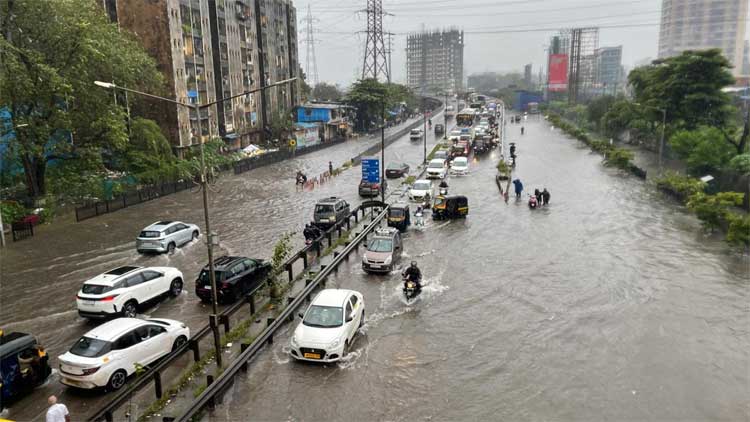
Incessant rains have lashed Mumbai and its suburbs for four straight days, paralysing daily life and leaving parts of the city waterlogged. Experts warn that climate change is intensifying such extreme rainfall events, stressing the urgent need for early warning systems, better planning, and resilient infrastructure.
IMD Forecast: More Showers Ahead
The India Meteorological Department (IMD) has forecast continued heavy rains over the next 24 hours, followed by a gradual decline in intensity. Moderate showers, however, are expected to persist through the week.
Rainfall Surpasses August Average
After a parched July, rains returned with fury around August 16. By the afternoon of August 19, Mumbai had already received over 800 mm of rainfall—well above the monthly average of 560.8 mm.
What’s Driving the Downpour?
Meteorologists attribute the deluge to the rare alignment of multiple weather systems.
-
A low-pressure area over Vidarbha,
-
A cyclonic circulation over the Northeast Arabian Sea,
-
A depression over the Bay of Bengal, and
-
An active offshore Monsoon trough
…all combined to create vigorous monsoon conditions along coastal Maharashtra.
“When such systems align, they amplify each other, leading to extreme weather,” explained Mahesh Palawat, VP (Meteorology & Climate Change), Skymet Weather.
Climate Change: The Hidden Driver
While three-digit rainfall is not new to Mumbai, climate scientists caution that climate change is acting like a “steroid,” amplifying rainfall intensity.
“The northward swing of monsoon winds is pulling massive moisture from the Arabian Sea into the northern Western Ghats,” said Dr. Raghu Murtugudde, Emeritus Professor, University of Maryland. He noted that global warming, especially rapid warming over the Middle East, is altering monsoon wind patterns.
A recent study shows the Middle East is warming nearly twice as fast as other inhabited regions, contributing to increased instability and heavier rainfall over northwest India and Pakistan.
Mumbai’s Wettest August in Years
“This spell follows the city’s driest July since 2015,” said Dr. Akshay Deoras, Research Scientist, University of Reading, UK. He linked the rains to strong monsoon winds intensified by two low-pressure systems—over east India and the Gulf of Khambat.
He added that short, intense bursts of rain align with what is expected in a warming climate.
Call for Citizen-Centric Early Warning Systems
Experts agree the way forward lies in robust forecasting and disaster preparedness.
“The Arabian Sea is warming exponentially, increasing moisture influx,” said Dr. Subimal Ghosh, IIT Bombay. “We need citizen-centric early warning systems so people can make real-time, informed decisions.” He pointed to IIT Bombay’s Mumbai Flood Monitoring System, which provides real-time updates to authorities.
Former IMD chief K.G. Ramesh called for stronger inter-agency coordination, saying: “Forecasting has improved, but dissemination and evacuation planning remain weak.”
Building Urban Resilience
Experts also urged structural interventions:
-
Mapping flood-prone zones
-
Upgrading drainage systems
-
Expanding green cover
-
Using Intensity-Duration-Frequency (IDF) models to anticipate rainfall hotspots
CEEW’s Thane City Flood Risk Action Plan 2024 uses 52 years of rainfall data to identify vulnerable zones and design ward-level flood indices—an approach experts say Mumbai must adopt.
Preparing for a Future of Extreme Events
“Floods now cause the highest disaster-related losses,” said Abinash Mohanty, IPE Global. With IPE Global assisting the BMC on an AI-ML-powered Multi-Hazard Risk Atlas, he warned that without climate-proofing, megacities like Mumbai will remain highly vulnerable.
Experts caution that such extreme events will no longer be rare. “Whether in Mumbai or the Himalayas, early warnings and adaptation strategies are the only way forward,” one said.
Comments are closed.