
BRICS Slams EU’s Carbon Border Tax as Trade Discrimination in Green Disguise

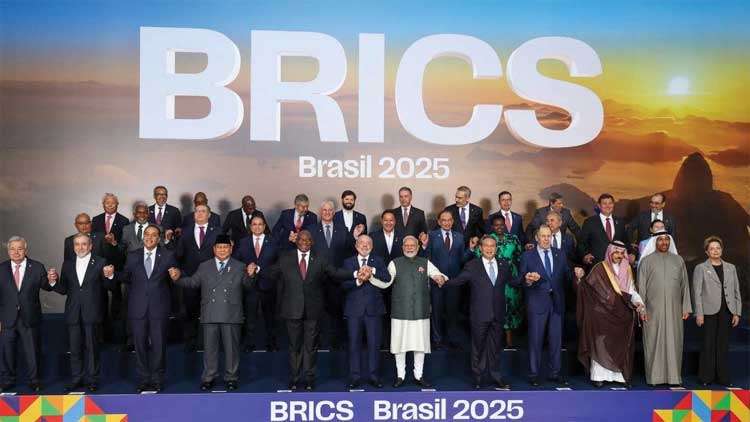
In a coordinated and strongly worded diplomatic rebuttal, the BRICS nations — Brazil, Russia, India, China, and South Africa — have united to denounce the European Union’s Carbon Border Adjustment Mechanism (CBAM), calling it a veiled trade barrier masquerading as climate action.
While the EU defends CBAM as a necessary tool to prevent carbon leakage and ensure climate accountability, emerging economies view it as a blatantly unfair move that penalises developing nations and undermines the principles of equity enshrined in the Paris Agreement.
CBAM: Climate Justice or Green Protectionism?
Set to take full effect from 2026, CBAM is a carbon levy on imports such as steel, cement, aluminium, fertilisers, and electricity. Under this mechanism, non-EU exporters will be required to pay for the carbon emissions embedded in their goods at rates mirroring those faced by EU producers under the bloc’s Emissions Trading System (ETS). The price of these certificates, tied to EU ETS auctions, has fluctuated between €60 and €90 per tonne of CO₂ in recent years.
Although designed to prevent carbon-intensive industries from shifting operations to countries with weaker environmental regulations, BRICS nations argue the mechanism is essentially a green-tinted trade barrier that imposes disproportionate burdens on the Global South.
Representing 41% of the world’s population and nearly 40% of global GDP (PPP), the BRICS bloc contends that CBAM violates the principles of Common But Differentiated Responsibilities (CBDR) and ignores the historical emissions and differing capacities of nations. Instead of assisting developing countries in their energy transition, they say the EU is shifting the cost of decarbonisation onto economies still dealing with poverty, infrastructure deficits, and late-stage industrialisation.
India Faces Major Impact
Among the BRICS members, India is particularly exposed. According to a report by Grant Thornton Bharat, Indian steel exporters alone could face cumulative losses exceeding $551 million by 2034 due to CBAM. In FY2022-23, India exported over $3 billion worth of steel to the EU, accounting for nearly 23.5% of its total steel exports.
Other sectors such as aluminium and cement are also vulnerable. India’s aluminium industry, for instance, emits around 20 tonnes of CO₂ per tonne of primary aluminium, significantly higher than the EU average of 6.5–7 tonnes. This disparity could lead to steep cost penalties under the CBAM regime, making Indian exports less competitive.
Comments are closed.