
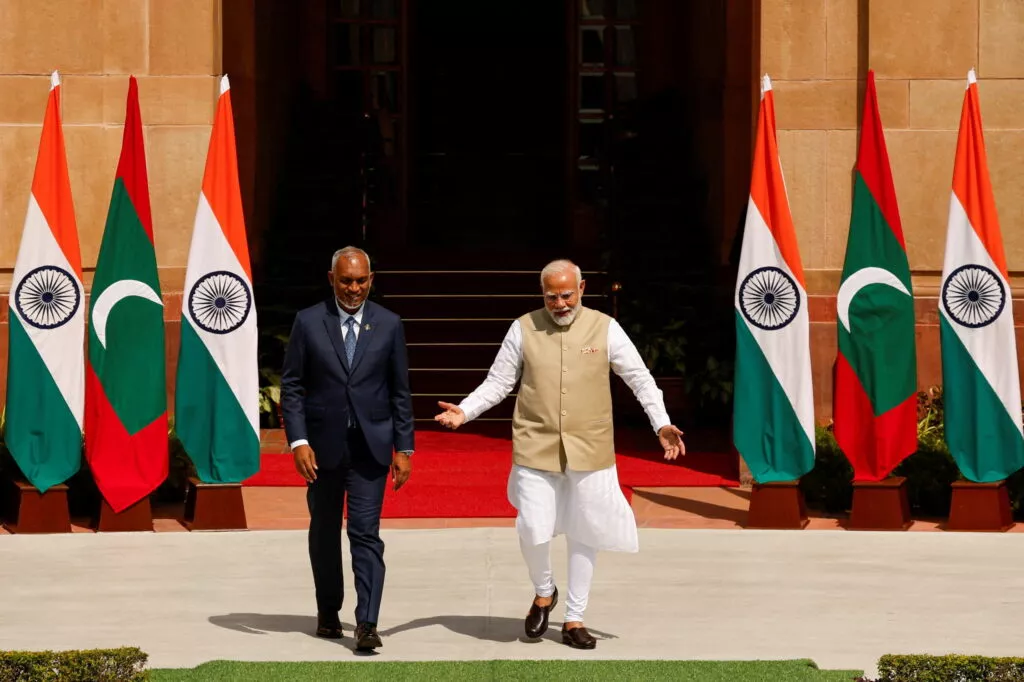
Prime Minister Narendra Modi’s visit to the Maldives as the Guest of Honour for the nation’s 60th Independence Day celebrations marked a significant milestone in India-Maldives relations. This state visit, the first by a foreign leader under President Mohamed Muizzu’s administration, symbolized a remarkable turnaround from the tensions of 2023–2024, when Muizzu’s “India Out” campaign had strained bilateral ties. India’s strategic diplomacy, blending economic aid, soft power, and measured restraint, transformed the narrative from confrontation to cooperation, reasserting India’s role as a trusted partner in the Indian Ocean Region (IOR). This article explores the context of the diplomatic rift, India’s strategic response, the pivotal role of Modi’s leadership, and the broader implications for regional geopolitics.
Background: The India-Maldives Diplomatic Rift
The Maldives, a strategically vital archipelago in the IOR, has historically been a close ally of India, benefiting from economic aid, security cooperation, and cultural ties. However, relations faced challenges following the 2023 election of President Mohamed Muizzu, who campaigned on an “India Out” platform, promising to reduce Indian influence and remove approximately 90 Indian military personnel stationed in the Maldives for humanitarian and surveillance operations. Muizzu’s rhetoric, rooted in nationalist sentiment and amplified by disinformation campaigns, portrayed Indian presence as a threat to Maldivian sovereignty. His early actions, including prioritizing a state visit to China over India and scrapping a hydrographic survey agreement with India, signaled a pro-China tilt.
Tensions escalated in January 2024 when three Maldivian deputy ministers—Mariyam Shiuna, Malsha Shareef, and Abdulla Mahzoom Majid—made derogatory remarks on X, calling Prime Minister Modi a “clown,” “terrorist,” and “puppet of Israel” after his visit to Lakshadweep, which some interpreted as an attempt to promote Indian tourism at the Maldives’ expense. The remarks triggered a #BoycottMaldives movement in India, led by celebrities and travel platforms like EaseMyTrip, causing a 42% drop in Indian tourist arrivals in early 2024, from 11.2% of total visitors in 2023 to 6%. With tourism contributing 30% to the Maldives’ GDP, the boycott posed a significant economic threat.
Muizzu’s initial alignment with China, including $1.37 billion in loans under the Belt and Road Initiative, deepened India’s concerns about losing strategic influence in its maritime backyard, especially as China expanded its naval presence in the IOR. However, India’s deft diplomacy, rooted in its “Neighbourhood First” policy and Vision SAGAR (Security and Growth for All in the Region), turned the tide.
India’s Strategic Diplomacy
India’s response to the Maldives’ provocations was characterized by strategic patience, economic leverage, and soft power:
-
Economic Assistance: Facing a financial crisis with foreign exchange reserves at $440 million (covering only 1.5 months of imports) and a 110% GDP-to-debt ratio, the Maldives sought India’s help. In May and September 2024, India rolled over $100 million in Treasury Bills via the State Bank of India and provided a $760 million currency swap agreement ($400 million and ₹3,000 crore) under the SAARC framework, averting a potential default on an Islamic sukuk bond. These measures provided critical liquidity to the Maldives’ economy.
-
Soft Power and Restraint: Despite the #BoycottMaldives campaign, India avoided retaliatory rhetoric. Modi’s early congratulatory message to Muizzu in November 2023 and high-level engagements, such as External Affairs Minister S. Jaishankar’s visit in August 2024, set the stage for dialogue. Muizzu’s suspension of the three deputy ministers and their subsequent resignations before his October 2024 India visit signaled a softening of anti-India sentiment.
-
Development Projects: India continued to support key infrastructure projects, including the $500 million Greater Malé Connectivity Project, a commercial port at Thilafushi, and 700 housing units, reinforcing its role as a reliable partner. The launch of India’s RuPay card in the Maldives and discussions for a Free Trade Agreement (FTA) further deepened economic ties.
-
Security Cooperation: India replaced military personnel with technical staff by May 2024, addressing Muizzu’s concerns while maintaining maritime security cooperation through joint exercises like Dosti with Sri Lanka. Agreements to enhance the Maldives National Defence Force (MNDF) and provide training under India’s ITEC program underscored continued defense collaboration.
Modi’s personal engagement, including meetings with Muizzu at COP28 in December 2023 and during Muizzu’s visits to New Delhi in June and October 2024, fostered trust. The invitation for Modi to attend the Maldives’ Independence Day in July 2025, a symbolic gesture, marked a diplomatic triumph.
Modi’s Carrot-and-Stick Approach
Modi’s diplomacy blended incentives with subtle pressure, often described as a “carrot-and-stick” strategy:
-
Carrot: India’s timely financial aid and infrastructure support addressed the Maldives’ economic vulnerabilities, making it clear that India was a dependable partner in times of need, unlike China’s debt-heavy approach. Muizzu acknowledged India as a “first responder” during crises like the 2014 Malé water crisis and the COVID-19 pandemic.
-
Stick: The #BoycottMaldives campaign, amplified by Indian public sentiment and Modi’s promotion of Lakshadweep as a tourism alternative, exerted economic pressure. Modi’s Lakshadweep visit in January 2024, showcasing India’s own pristine islands, was perceived as a strategic move to highlight viable alternatives, reducing the Maldives’ leverage as a tourist destination.
This approach compelled Muizzu to recalibrate, as the Maldives’ economy could ill afford to alienate India, its largest tourism market in 2023 (209,198 arrivals). Muizzu’s public statements by October 2024, emphasizing India as a “key partner” and urging Indian tourists to return, reflected this shift.
Broader Implications
The restoration of India-Maldives ties has significant implications:
-
Geopolitical: The reset counters China’s growing influence in the IOR, where the Maldives’ strategic location along key sea lanes is critical. India’s strengthened partnership ensures it remains the net security provider, aligning with the SAGAR doctrine and the QUAD’s Indo-Pacific strategy.
-
Economic: The Maldives benefits from India’s financial aid and infrastructure projects, while India secures a stable partner for trade and maritime security. The proposed FTA and RuPay card integration could boost bilateral trade, addressing the trade imbalance favoring India.
-
Social: The revival of people-to-people ties, strained by the boycott, fosters mutual trust. Muizzu’s call for Indian tourists to return aims to restore the Maldives’ tourism sector, while India’s medical and educational support strengthens cultural bonds.
-
Regional Stability: The reset sets a precedent for India’s diplomacy in South Asia, demonstrating its ability to navigate regime changes and anti-India rhetoric, as seen in similar successes with Sri Lanka under President Anura Kumara Dissanayake.
Challenges
-
Domestic Politics in Maldives: Muizzu must balance nationalist sentiments and his “Maldives First” policy with India’s expectations, risking domestic backlash if perceived as overly conciliatory.
-
China’s Influence: China’s $1.37 billion debt hold and ongoing investments in the Maldives remain a challenge, requiring India to sustain economic and strategic engagement to counter Beijing’s influence.
-
Sustainability of Tourism Recovery: Restoring Indian tourist numbers depends on consistent messaging and addressing perceptions of hostility from the 2024 spat.
-
Regional Rivalries: India must navigate broader IOR dynamics, including China’s ties with Sri Lanka and Pakistan, to maintain its regional dominance.
Path Forward
To sustain and build on this diplomatic success:
-
Deepen Economic Ties: Accelerate the FTA and expand infrastructure projects like the Greater Malé Connectivity Project to cement economic interdependence.
-
Strengthen Security Cooperation: Enhance joint maritime exercises and MNDF training to reinforce India’s role as the primary security partner.
-
Promote Soft Power: Encourage Indian tourism through targeted campaigns and leverage cultural exchanges, such as educational scholarships and medical tourism, to rebuild trust.
-
Engage Proactively: Regular high-level visits and dialogue through the India-Maldives Core Group can prevent future misunderstandings and counter disinformation.
-
Counter China Strategically: Offer sustainable development aid to reduce the Maldives’ reliance on Chinese loans, aligning with India’s vision of a free and open Indo-Pacific.
Comments are closed.