
NCERT Revises Class 8 Textbook to Highlight Religious Intolerance During Sultanate and Mughal Eras

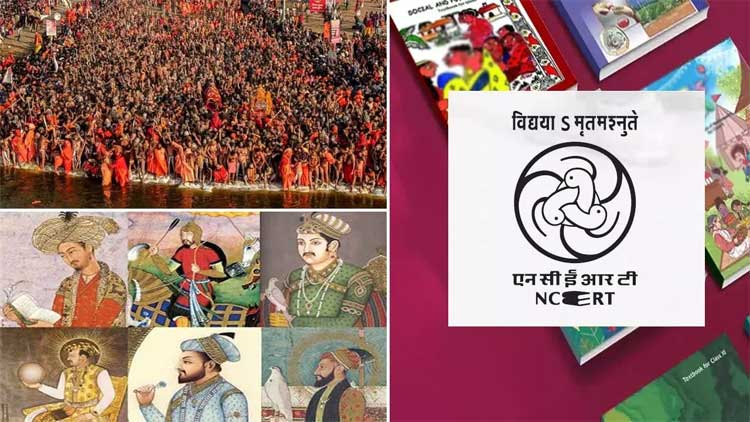
The National Council of Educational Research and Training (NCERT) has revised its Class 8 social science textbook to include new content highlighting instances of religious intolerance during the Delhi Sultanate and Mughal periods. The updated book describes figures such as Babur, Akbar, and Aurangzeb in stark terms, referencing acts of violence, temple destruction, and religious suppression.
According to The Indian Express, Babur is portrayed as a “brutal and ruthless conqueror, slaughtering entire populations of cities,” Akbar’s rule is described as a “blend of brutality and tolerance,” and Aurangzeb is cited for destroying temples and gurdwaras.
NCERT has included a disclaimer with the revisions in a section titled “Note on Some Darker Periods in History”, emphasizing that no individual or group today should be held responsible for past events. The council states the updated content aims to present an “honest, balanced, and evidence-based” view of history.
What’s New in the Class 8 Book?
The revised book, Exploring Society: India and Beyond (Part 1), introduces students to Indian history from the 13th to 17th centuries, covering the Delhi Sultanate, the Vijayanagara Empire, the Mughals, and the rise of the Sikhs. The chapters under “Reshaping India’s Political Map” explore military campaigns, political instability, destruction of cities and temples, and resistance movements.
Previously, this period was introduced in Class 7, but under the National Education Policy (NEP) 2020 and the National Curriculum Framework for School Education 2023, the content has now been shifted to Class 8. The new textbook replaces earlier versions that omitted many of the more violent or controversial aspects of this historical era.
NCERT’s Justification
Defending the revisions, NCERT said the events included “did happen and left their mark on Indian history.” The agency emphasized that the content is grounded in historical evidence and intended to encourage critical reflection, not blame.
“In addition to the ‘Note on Some Darker Periods in History,’ a cautionary note has been inserted to clarify that no one today should be held accountable for past events,” NCERT said in an official statement. “The emphasis is on drawing meaningful lessons for a better future.”
The updated Class 8 textbook is part of NCERT’s ongoing rollout of revised materials under the NEP 2020. New books for Classes 1 to 4, as well as Classes 6 and 7, have already been introduced. Textbooks for Classes 5 and 8 are currently being released.
Comments are closed.