
Fakir Mohan College Student Dies After Self-Immolation Over Sexual Harassment Complaint; North Odisha Erupts in Protest

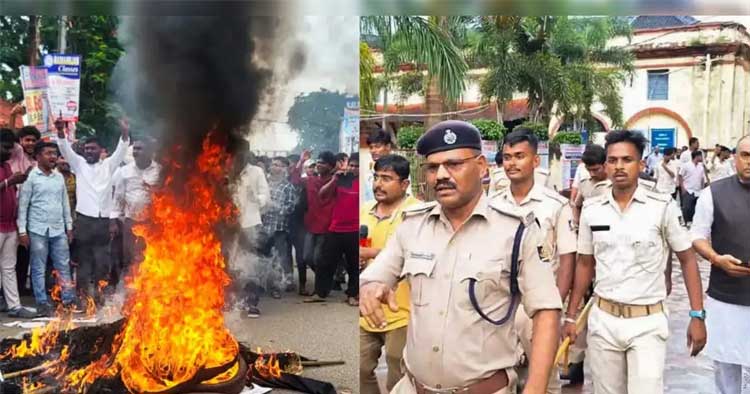
A 20-year-old student from Fakir Mohan Autonomous College in Balasore, Odisha, who attempted self-immolation in protest against the inaction on her sexual harassment complaint, succumbed to her injuries late Monday night at AIIMS Bhubaneswar.
The second-year B.Ed (integrated) student had set herself ablaze on Saturday outside the college principal’s office after learning that the Internal Complaints Committee (ICC) had given a clean chit to the accused, Professor Samir Kumar Sahu — head of the education department. She had accused Sahu of repeated sexual harassment and intimidation, including threats to fail her in exams if she did not comply with his demands.
Medical Response and Death
According to a medical bulletin issued by AIIMS Bhubaneswar, the girl was brought to the emergency ward on July 12 and put on mechanical ventilation. Despite resuscitative efforts and advanced care in the Burns ICU, including renal replacement therapy, she was declared clinically dead at 11:46 PM on July 14.
Political and Public Outrage
Odisha Chief Minister Mohan Charan Majhi expressed his grief and vowed “strictest punishment under law” for those found guilty. President Droupadi Murmu visited the victim in hospital on Monday evening and met her family. Governor Hari Babu Kambhampati called on the state to act with urgency and sensitivity, emphasizing the need to ensure students’ safety and dignity.
The incident has sparked widespread protests across Odisha. Student and women’s wings of the ruling BJD protested at Fakir Mohan College, while Congress leaders gheraoed the Balasore district collector’s office. Opposition parties have called for the resignation of CM Majhi, Higher Education Minister Suraj Suryabanshi, and Union Education Minister Dharmendra Pradhan.
The Complaint and Institutional Failure
The victim’s ordeal reportedly began six months ago. Despite raising the matter with college authorities and sending distress messages via social media to top officials including the CM, Union Education Minister, and NCW, no action was taken.
On June 30, Sahu allegedly barred her from sitting for an exam, citing low attendance. She and members of the ABVP wrote to the principal, triggering a brief protest and the eventual formation of an ICC — which the college reportedly lacked until then.
However, the ICC’s probe was seen as flawed. The panel allegedly excluded student members, conducted a rushed inquiry, and failed to counsel the victim. It ultimately exonerated Sahu in a report submitted on July 10.
On July 13, a day before her death, the student confronted Principal Dilip Ghosh, who allegedly pressured her to withdraw her complaint or face rustication. Feeling cornered, she set herself on fire in front of his office.
Arrests and Government Response
Following the incident, police arrested both Sahu and principal Dilip Ghosh. Ghosh was suspended after reports surfaced that he shielded the accused and allegedly threatened the student with expulsion.
The Odisha government has now directed all universities and colleges to constitute Internal Complaints Committees under the Sexual Harassment of Women at Workplace Act, 2013, within 24 hours, and to publicly display contact information of committee members.
A Pattern of Neglect
The student’s father, a college clerk, said his daughter had twice attempted suicide due to prolonged harassment. He said she had been punished for low attendance despite being ill, dealing with family bereavements, and participating in college-led self-defense training as a master trainer.
“She told me she wanted to meet the Higher Education Minister but couldn’t. When she went to the principal, he humiliated her and warned her to withdraw the complaint. She saw no way out,” her father said.
Friends said the professor deliberately failed her in exams and instigated male students to mock her publicly. Despite her repeated complaints, the college authorities took no meaningful action.
A Tragic End, A Systemic Failure
The student’s desperate final act has exposed grave lapses in how institutions handle sexual harassment complaints. While arrests and inquiries are now underway, her death has intensified public anger and raised urgent questions about the failure of internal redressal systems — and whether institutional complicity cost a young woman her life.
Comments are closed.