
Wildfire Closes Grand Canyon’s North Rim, Disrupting a Season at One of America’s Most Iconic Parks

Nearly five million people visited Grand Canyon National Park last year — from day trippers and hikers to those staying overnight in historic lodges.
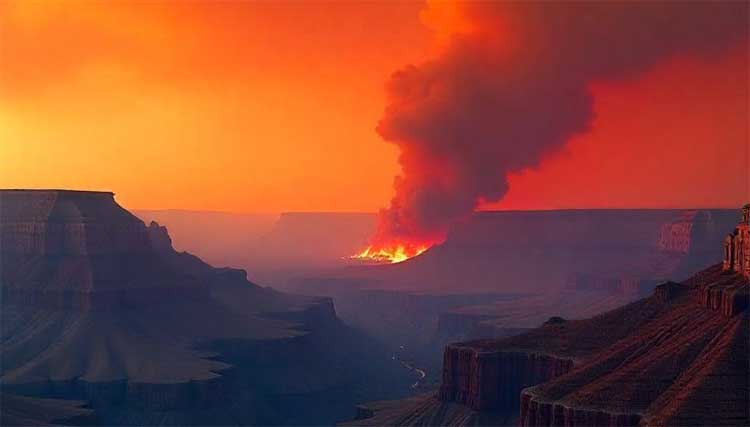
But 2025 will be a different story, at least for part of the park. A wildfire has ravaged the North Rim, destroying a historic lodge and cabins, and forcing its closure for the rest of the season.
As firefighters continue efforts to contain the blaze, here’s a closer look at the park and why the North Rim holds a special place in its history.
Bigger Than a State
Spanning approximately 1,900 square miles — larger than Rhode Island — Grand Canyon National Park stretches across northwestern Arizona. The canyon itself runs about 278 miles along the Colorado River, from the Utah border to near Nevada. Its colorful rock walls, carved over millions of years, average a depth of one mile and a width of 10 miles.
As writer Lance Newman once noted, “Four Empire State Buildings stacked one atop the other would not reach the rim.”
North vs. South Rim
The South Rim, open year-round, is the park’s busiest area, home to its historic village district and popular viewpoints. In contrast, the North Rim — typically open from mid-May to mid-October — offers a quieter, more secluded experience and draws just 10% of annual visitors. But the recent wildfire has ended its 2025 season early, dealing a blow to travelers seeking solitude and to the park’s historical legacy.
Driving between the two rims takes about five hours due to the remote terrain and limited road access across the canyon. A hike across — just 21 miles — involves a steep and challenging descent, including a footbridge 70 feet above the Colorado River.
A Deep Past
Geologically, the Grand Canyon was formed by tectonic uplift and millions of years of erosion by the Colorado River. Human history here is equally rich: artifacts date back 12,000 years, reflecting early hunting, agriculture, and the development of trade routes. Eleven tribes, including the Hopi and Diné, maintain deep cultural ties to the canyon.
The first Europeans to see the Grand Canyon were members of a 1540 Spanish expedition led by Francisco Vázquez de Coronado. But tricked by the Hopi into believing the region was inhospitable, Europeans didn’t return for another 235 years.
In 1857, U.S. Army Lt. Joseph Christmas Ives dismissed the canyon as “altogether valueless” and predicted it “shall be forever unvisited.” Later expeditions by geologist John Wesley Powell in 1869 and 1871 changed that perception dramatically.
Preserving a Wonder
Visitors began arriving by stagecoach and later by train, turning the Grand Canyon into a major destination by the early 20th century. President Woodrow Wilson officially designated it a national park in 1919, though conservation efforts began earlier under President Theodore Roosevelt.
“Leave it as it is,” Roosevelt famously said. “You cannot improve on it. The ages have been at work on it, and man can only mar it.”
While the fire marks a tragic setback for part of the park, the grandeur and significance of the Grand Canyon — shaped by time, geology, and history — continue to endure.
Comments are closed.